A franchise is only as strong as its weakest location online. We build the system each location runs on: its own website, its own AI agent, its own CRM, and follow-up that happens whether anyone remembers or not. Built once, governed centrally, and rolled out location by location, with each location's own verified facts.
Start your free trial today. No credit card required. Then book a call with us and we will walk you through it.
A REAL BUILD: BEST OPTION RESTORATION
One flagship build.One template for the network.Every location's own facts.
THE PATTERN WE KEEP FINDING
Strong franchise, scattered online presence.
When we audit a franchise system, the operation is usually strong, and the online system is usually not built to the same standard. Locations run one-off websites in different styles, or no website at all. Social profiles follow no naming pattern, and some locations cannot be found at all. Reviews are earned by good work but never built on purpose, so the counts stay thin.
The biggest gap is demand. The customers a brand creates end up rented back from lead marketplaces, on pages that carry no franchise name, no local owner, and no lasting value for the location that does the work. The lead stream stops the moment the payments stop.
The fix is not a bigger ad budget. It is infrastructure: one governed system, built once, that every location runs on, filled with each location's own verified facts instead of templates dressed up as local.
Four pieces, built as one system, and repeated per location from a single governed template.
A lead system the locations own
Service landing pages built for search and ads, call tracking per service, and a ZIP code router that sends every lead straight to the location that serves that territory. Your locations own the funnel instead of renting leads from marketplaces.
An AI agent for every location
One shared knowledge base about your brand, plus a small per-location layer carrying that location's own confirmed facts: services, territory, hours, and booking rules. The guardrails are identical everywhere. It never invents prices, reviews, or service areas, and it routes emergencies to a human.
A CRM for every location
Each location gets its own pipeline and its own data, duplicated from one master template we govern. Leads, calls, texts, estimates, and jobs live in one place per location, with roll-up reporting for the system as a whole.
Follow-up automation
Speed wins in local services. Instant lead alerts, missed-call text-back, estimate follow-up, and a review request at the end of every job, structured once in the template and localized for each location.
THE WORKED EXAMPLE
Best Option Restoration, step by step.
Best Option Restoration is a national restoration franchise with 70-plus locations. Craig, who owns and runs one of those locations, asked us to build the online system for his location first, designed from day one to become the template for the whole network. Here is the method behind it, in the order we run it: audit, blueprint, build.
Step 1: The audit
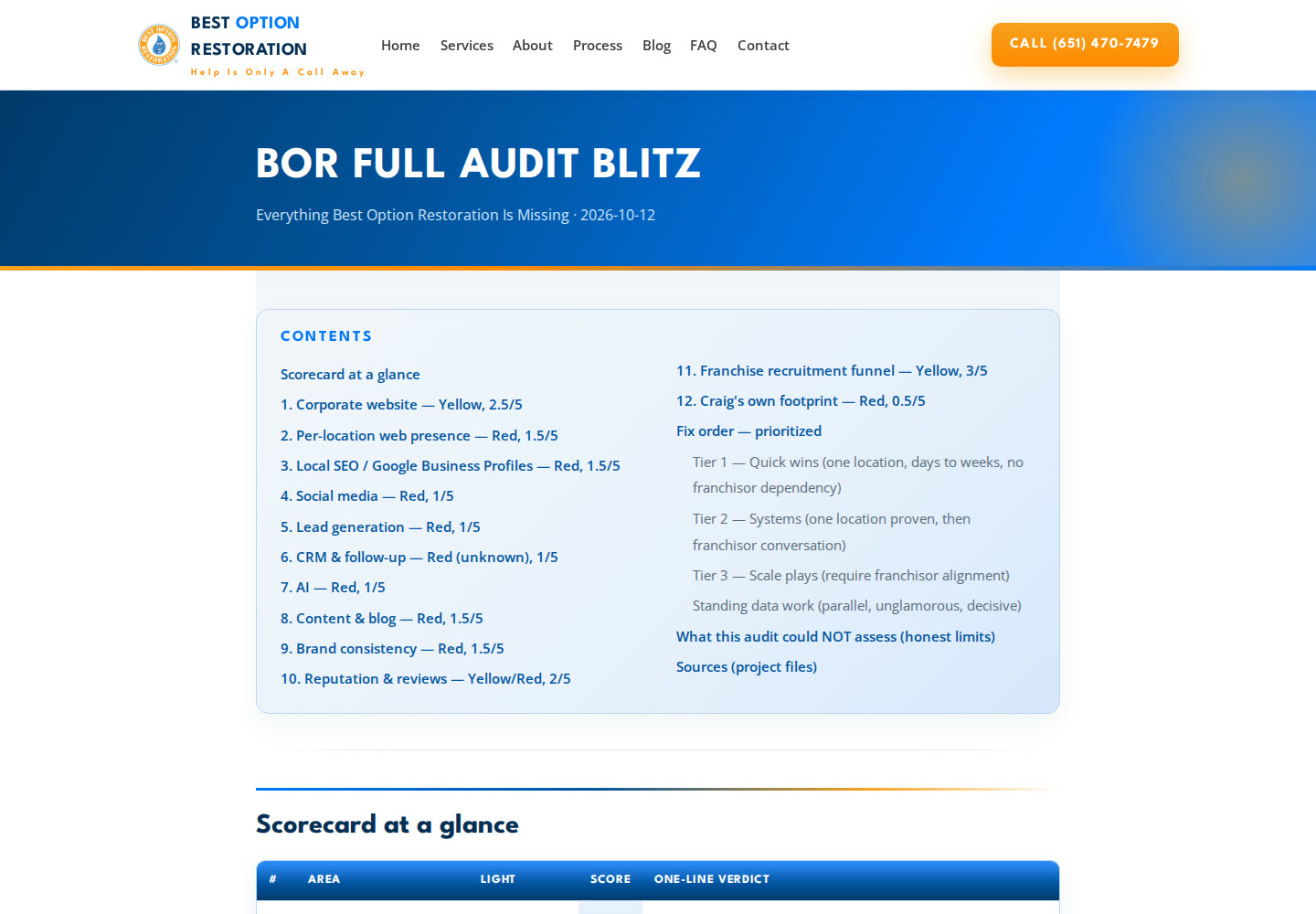
We started with a full audit of the franchise online: the corporate site, the location pages, social profiles, review profiles, and the lead flow. The findings were blunt. Of the 70-plus locations, only about half could be individually verified from public sources. Social presence was fragmented, with no consistent naming pattern. And customers searching for help were largely landing on third-party marketplace pages that carry no Best Option Restoration name at all.
The full audit: twelve areas scored, with a prioritized fix order.
Step 2: The blueprint
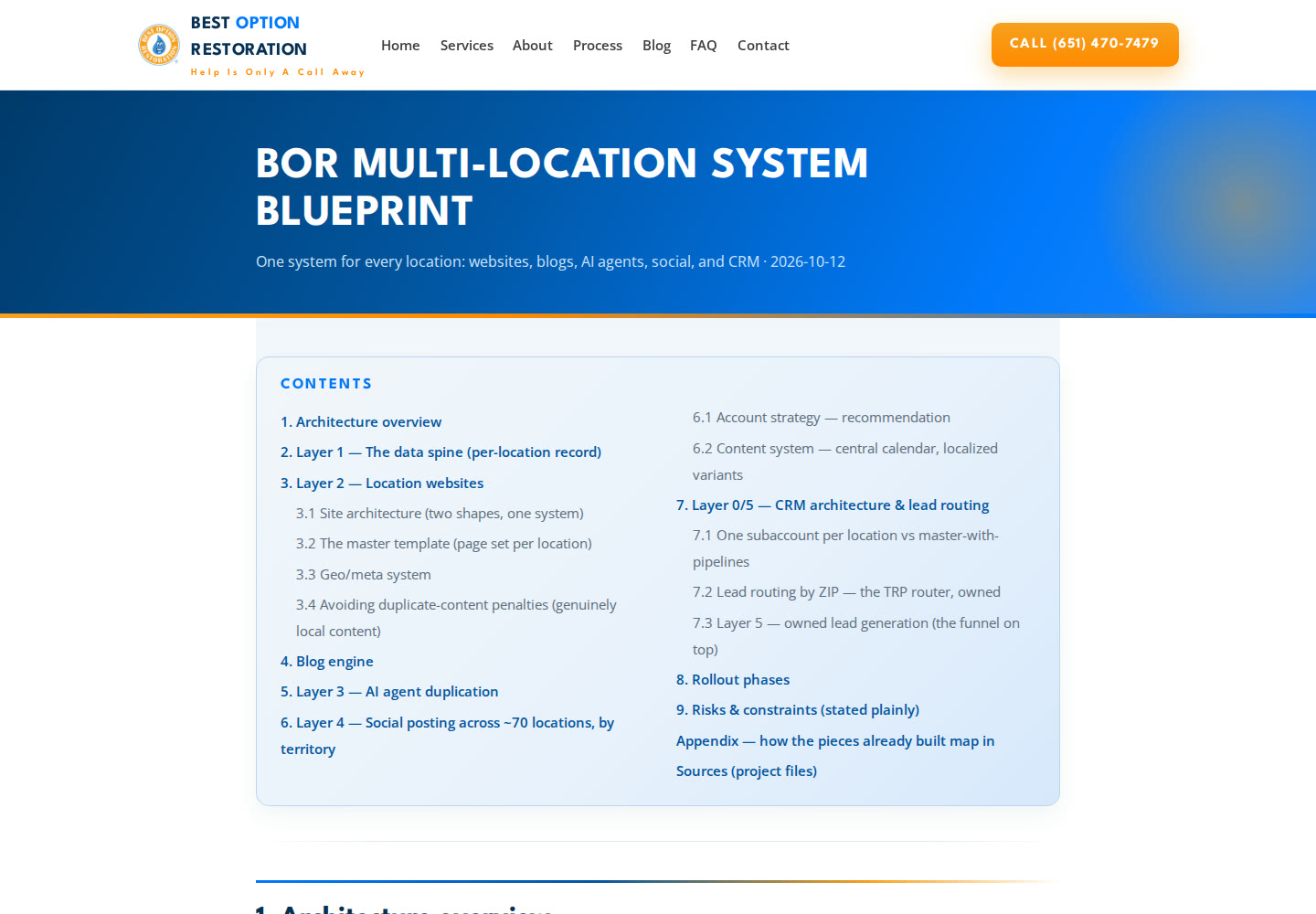
Then we wrote the multi-location blueprint: the architecture that turns one good location build into a system for the whole network. One verified data record per location. Location websites generated from one master template. An AI agent duplicated per location from one controlled knowledge base. Localized social posting by territory, including weather-triggered sequences for storm and freeze events. And one CRM per location, with every lead routed by ZIP code and tracked to the booked job.
The 70-location blueprint: five layers on one data spine.
Step 3: The build
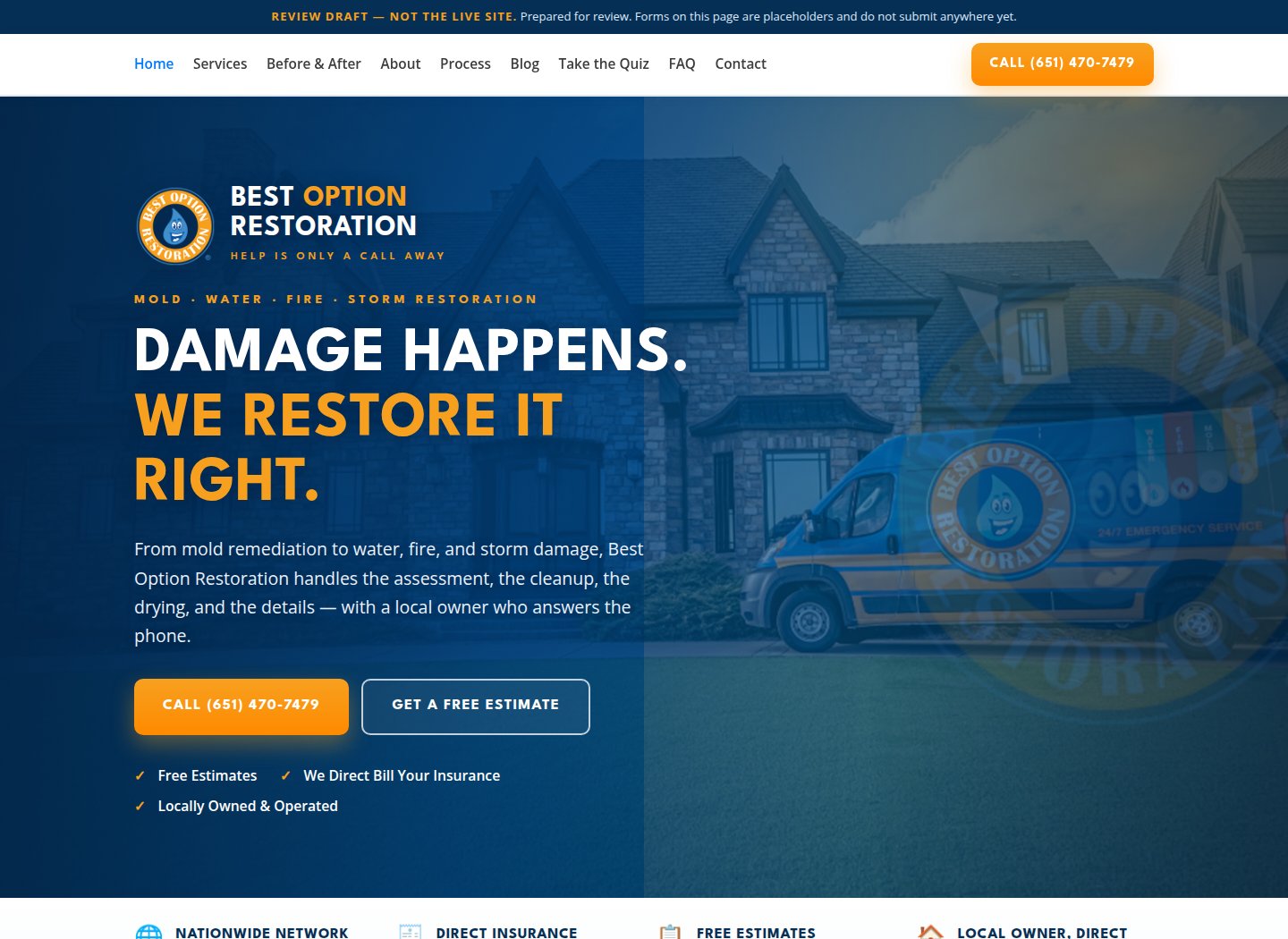
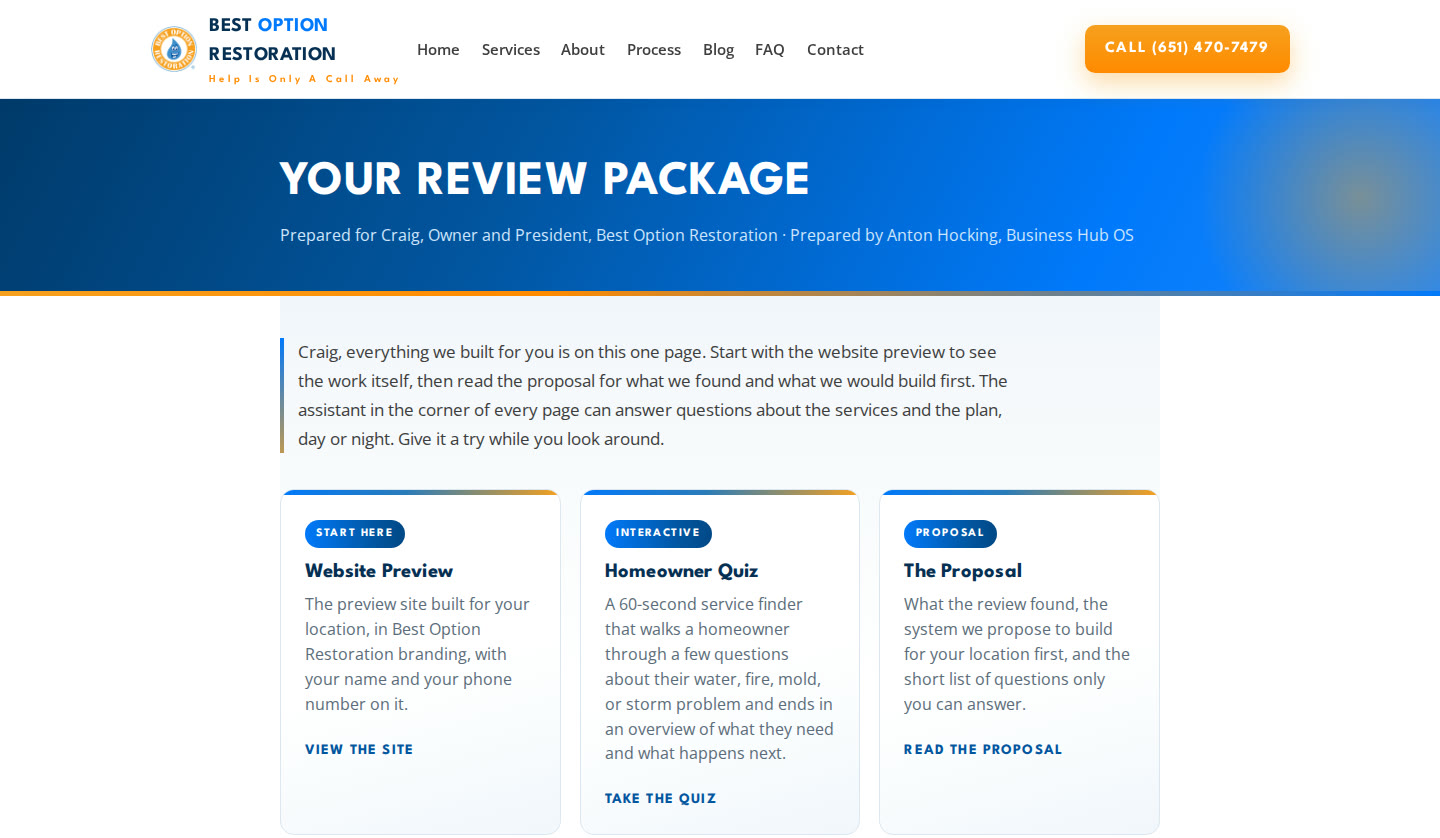
Then we build it, and we build the work before we ask anyone to buy the plan. Everything for Craig's location went into one review package he could actually judge: the website preview in his real branding (the site at the top of this page), a homeowner quiz that ends in a service overview, the proposal, and content examples in his branding, alongside the audit and the blueprint above.
The review package: every deliverable in one place.
The same discipline runs on every site we build, franchise or not: the client's real branding, facts the owner has confirmed, and follow-up built in from the start instead of bolted on later. Purple Solutions, a Florida insurance agency, runs on a site we built the same way: its coverage lines, its free review funnel, and its AI assistant, all in the agency's own branding.
Purple Solutions Insurance Agency: a client site we built and shipped.
That is the pattern on every engagement: audit first, blueprint second, then build the real thing and put it in front of the owner.
THE OTHER SIDE OF FRANCHISING
Franchise Pro: the buyer lead system.
Franchise systems also need the front end: people who want to buy in. For Franchise Pro, a franchise consulting platform, we built the buyer side of the system: a matching quiz that helps people find the right franchise opportunity, and a lead platform that delivers those buyers to franchisors and franchise development teams. Same discipline as the location system: one system, real follow-up, no rented demand.
We map the whole system first: brand, locations, lead flow, reviews, and follow-up. You see exactly what exists and what is missing, scored and prioritized, like the Best Option Restoration audit above.
2. Flagship build
We build one location, or one brand, completely: website, AI agent, CRM, follow-up, and review engine. It runs on real work, and the rough edges get fixed in the flagship, not in dozens of copies of it.
3. Template and rollout
The flagship becomes the governed template. Locations onboard in waves, each with its own verified facts confirmed by its owner before anything publishes. Network-wide brand use moves with franchisor alignment.
LISTEN AND WATCH
Hear it, then see it: the franchise build, explained.
Two short briefings from Business Hub OS on the problem every franchise system knows: a brand is only as strong as its weakest location online, locations rent back the demand the brand creates, and the fix is infrastructure, one governed system built once that every location runs on. Built from this page, nothing invented.
Why Franchises Must Own Their Leads (audio briefing)
Business Hub OS briefing · 18:56 · Why a franchise is only as strong as its weakest location online: scattered location websites, reviews never built on purpose, and demand rented back from lead marketplaces, and how one governed system, built once, fixes it.
Franchise Infrastructure (video)
Business Hub OS explainer · 6:47 · The weakest-location problem first, then the build service step by step: the audit, the flagship build, and the governed template rolled out location by location.
Do you work with franchisors or with individual franchisees?
Both, in the right order. A single location can start as the flagship, with its own owner calling the shots for that location. Network-wide rollouts, brand templates, and anything touching franchise sales move with franchisor alignment. We do not route around the franchisor.
Does every location really need its own CRM?
Yes. Franchisees run separate businesses, and each one should see only its own leads and customers. Every location gets its own CRM, duplicated from one governed template, so the structure stays identical while the data stays separate.
What stops the AI agent from inventing things about a location?
The agent only states facts that location has confirmed: services, territory, hours, and booking rules. The guardrails are identical at every location. It never invents prices, reviews, credentials, or service areas, and emergencies go straight to a human by phone.
Do locations have to give up their phone numbers or websites?
No. Locations keep their numbers. Existing location domains are redirected deliberately at migration, never abandoned, so whatever local search value they carry comes along.
How is this different from buying leads from a marketplace?
Marketplace leads stop the moment the payments stop, and the pages carry the marketplace brand, not yours. We build the funnel your system owns: landing pages, ZIP code routing, and follow-up that lands every lead in the right location's CRM, tracked to the booked job.
What does it cost?
It depends on the size of the system and how many locations roll out, so we scope it on a call rather than posting a number that would be wrong for your network. Start a free trial to see the platform, or book a call and we will map your flagship build.
How long does a rollout take?
The flagship build comes first and runs on real work. After that, locations onboard in waves. The schedule is set by verified data, not page generation: each location launches when its owner has confirmed its facts, so nobody publishes guesses about a real business.
Who writes the content for all those locations?
We produce content centrally, once, and localize it honestly: each location gets its own towns, its own jobs, its own owner, and its own reviews on its pages. Locations that cannot supply local proof yet launch with fewer pages rather than thin copies of everyone else.
MORE WAYS WE BUILD
The same system, fitted to the business.
Plumbers
The phone rings while you're under a sink. 24/7 answering, missed-call text-back, and estimate follow-up for plumbing shops.
Start your free trial to see the platform your locations would run on, or book a call and we will map the flagship build for your system. No credit card required to start. We wrote about exactly this in The Location Nobody Can Find.
Your details go straight to our team and we will get your free trial set up. Prefer to talk? Book a call with us.