
A homeowner has water coming through a ceiling at midnight. She searches the franchise brand she trusts, plus her town, expecting the local location.
What she finds instead is a lead marketplace page with a generic form. No local owner. No franchise name she recognizes. Or she finds a location page in a style from a decade ago, next to a second location in a completely different style, next to a third location that cannot be found at all.
She fills out the marketplace form anyway. She needs help tonight. And the brand that earned her trust rents its own customer back, on a page that carries no lasting value for the location that will do the work.
Strong operation, weak system
A franchise is only as strong as its weakest location online. That is the pattern our audits keep finding: the operation is usually strong, and the online system usually is not built to the same standard.
The trucks are wrapped. The training is solid. The work itself earns referrals. But the web presence underneath it grew location by location, owner by owner, year by year, with no governed system holding it together.
The three leaks
The first leak is scatter. Locations run one-off websites in different styles, or no website at all. Social profiles follow no naming pattern. Some locations cannot be found in search, full stop.
The second leak is reviews that were never built on purpose. The good work happens every day, and customers mean to say so, but nobody asks at the right moment, so the counts stay thin and the next customer sees a brand that looks smaller than it is.
The third leak is the biggest: demand rented back from lead marketplaces. The customers a brand creates end up sold back to its locations, on pages that carry no franchise name, no local owner, and nothing of lasting value for the location that does the work. The lead stream stops the moment the payments stop.
None of these leaks is fixed by a bigger ad budget. They are infrastructure problems, and they need an infrastructure answer: one governed system, built once, that every location runs on, filled with each location's own verified facts instead of templates dressed up as local.
What an audit of one national brand found
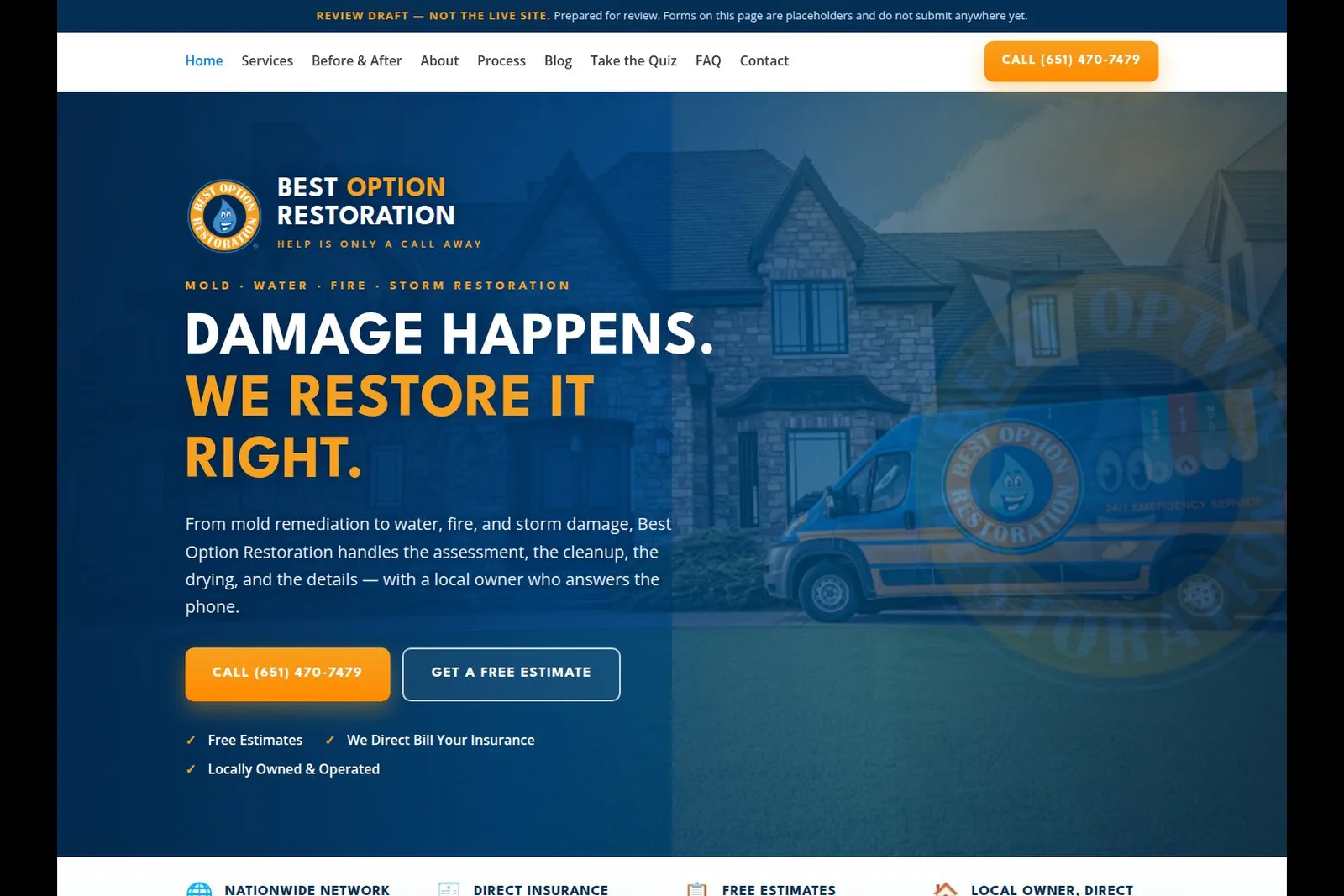
When a location owner named Craig, who owns and runs one location of Best Option Restoration, a national restoration franchise with 70-plus locations, asked us to build the online system for his location, he asked for it to be designed from day one to become the template for the whole network.
The audit came first. Of the 70-plus locations, only about half could be individually verified from public sources. Social presence was fragmented, with no consistent naming pattern. And customers searching for help were largely landing on third-party marketplace pages that carry no Best Option Restoration name at all. The audit scored twelve areas and set a prioritized fix order.
That is one engagement's story, told the way the audit found it. It is also the shape of the problem most franchise systems are carrying without a map of it.
Build once, then roll it out
The fix is not a redesign contest across dozens of locations. It is a flagship, a template, and a rollout.
First, one location gets built completely: website, AI agent, CRM, follow-up, and review engine, running on real work, so the rough edges get fixed in the flagship and not in dozens of copies. Then the flagship becomes the governed template, and locations onboard in waves, each with its own verified facts confirmed by its owner before anything publishes.
Underneath sit five layers on one data spine. One verified data record per location. Location websites generated from one master template. An AI agent duplicated per location from one controlled knowledge base, stating only facts that location has confirmed, never inventing prices, reviews, or service areas, and routing emergencies straight to a human. Localized social posting by territory, including weather-triggered sequences for storm and freeze events. And one CRM per location, with every lead routed by ZIP code and tracked to the booked job.
Every location keeps its phone number. Existing location domains are redirected deliberately at migration, never abandoned, so local search value carries along. Each location sees only its own leads and customers, because franchisees run separate businesses. And network rollouts move with franchisor alignment: a single location can start as the flagship with its own owner calling the shots, but brand templates and anything touching franchise sales go through the franchisor. We do not route around them.
Your brand earned that customer
The brand did the hard work: the name, the trust, the national reputation that made a homeowner search for it at midnight. The locations should be the ones who keep that customer, on pages they own, inside a system built once and governed properly.
Start your free trial today to see the platform, no credit card required. See how the build works for franchise systems: businesshubos.com/franchises.