
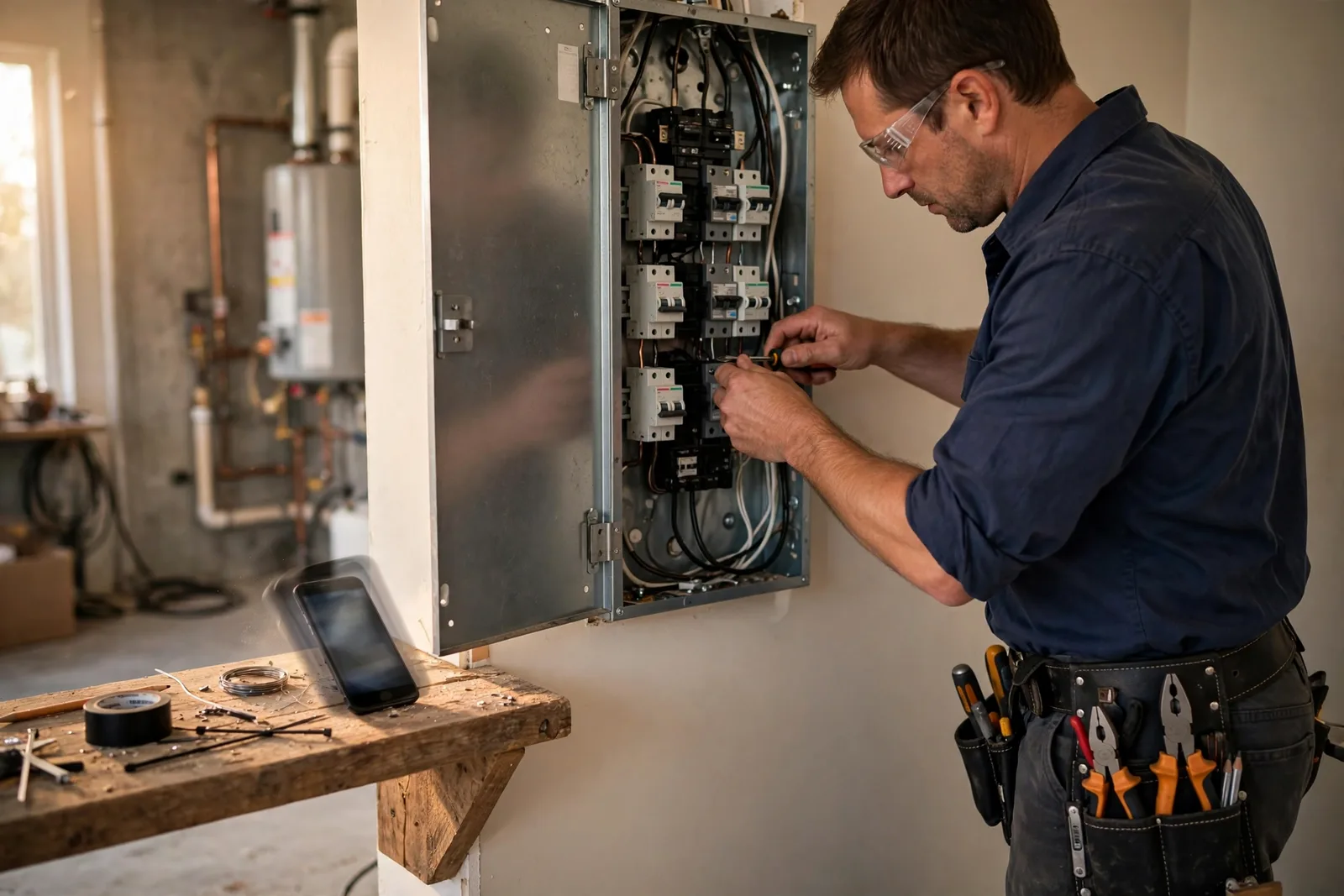
You are on a ladder with both hands in an open panel. Wire in one hand, the job half done, a house waiting for its power back. And your phone is ringing in the truck.
It rings four times and stops. You finish the job, climb down, check the phone. Missed call, no voicemail. You call back twenty minutes later. Straight to their voicemail. They already called the next electrician on the list.
That missed call was a job you never got to quote. It went to whoever picked up.
Stopping is not always safe, and never free
Electrical work adds a problem most trades do not have: answering is not just inconvenient, it can be unsafe. A hand leaves the panel, your focus leaves the work, and live work does not forgive distractions. So the phone rings out, not because you do not care, but because you are working the way you are supposed to.
The customer on the other end does not know that. They have a sparking panel, a dead outlet, or a panel upgrade they are ready to book. They are calling three companies and hiring the first one that answers. Industry research puts it at over 80% of first-time callers who hang up and dial the next name instead of leaving a voicemail.
The cruel math of the missed call
The pattern shows up in every study of small business phones. BrightLocal found 62% of small business calls go unanswered. Home service data puts roughly 27% of inbound calls missed, and 2026 call data from Invoca suggests close to half of home service calls never reach a person.
First response decides the rest. Remodeler case data shows 78% of homeowners award the project to the first responder. You can be the best electrician in town and still lose the panel upgrade to a shop that simply picked up faster.
Run the math the way our electricians page does, with plainly illustrative numbers: a $500 average job, 40 calls a week, 30% of them missed, 40% of the reached ones booked. That comes to roughly $2,400 a week, about $125,000 a year, walking to the next shop. Those figures are illustrative starting points from published home service data, not an electrician industry survey. Your numbers will differ. The direction will not.
The 2 AM problem
After hours is where electrical calls stop being routine. A sparking panel or a burning smell at 2 AM cannot sit in voicemail until morning, and it should not have to. CallRail's 2026 data shows 41% of online-booked jobs arrive outside business hours, so the night is not a small slice of the work.
But treat every late night call as an emergency and the on-call tech burns out. Treat none of them that way and a family with a sparking panel waits until morning. Somebody has to sort the dangerous from the routine at 2 AM. That sorting is a job in itself, and right now it lands on whoever is already exhausted.
The estimates you already sent
The quiet leak is the quote you already wrote. Panel upgrades, EV charger installs, lighting projects, rewires: you measured, you priced, you sent the estimate. Then silence. Not because the customer said no. Because nobody followed up, and without follow-up only about 20 to 30% of first-time customers ever call again on their own.
Every silent estimate is work you already did the hard part of. The customer found you and trusted you enough to ask for a price. Then they drifted to whoever stayed in touch.
What "always answered" actually looks like
The fix is not hiring someone to sit by the phone, and it is not answering from the ladder. It is making sure every call gets a live response, even when every human is busy.
When a call comes in during a job, it gets answered in your business voice, with electrical triage. A sparking panel gets urgency, safety guidance, and dispatch by your rules. A dead outlet gets booked for the morning. Urgent calls ring you or your on-call tech immediately, and the AI identifies itself as your business's AI assistant when a caller asks.
If a call still slips through, the missed-call text-back fires in seconds, with a booking link, and a summary lands with you by text or email. Every estimate you send gets timed, polite follow-up in your voice, and the moment a customer replies, a person takes over. Calls, texts, bookings, and estimates all land in one CRM and book straight into your connected calendar. Nothing to install in the truck.
Setup is three steps: keep your number, tell it your business (services, service area, hours, dispatch rules), and it starts answering, texting back, booking, and following up in one inbox.
You cannot be in two places at once, and you should never have to choose between safe work and an answered phone. Your business can do both. Stop losing jobs to the ringing phone in the truck.